
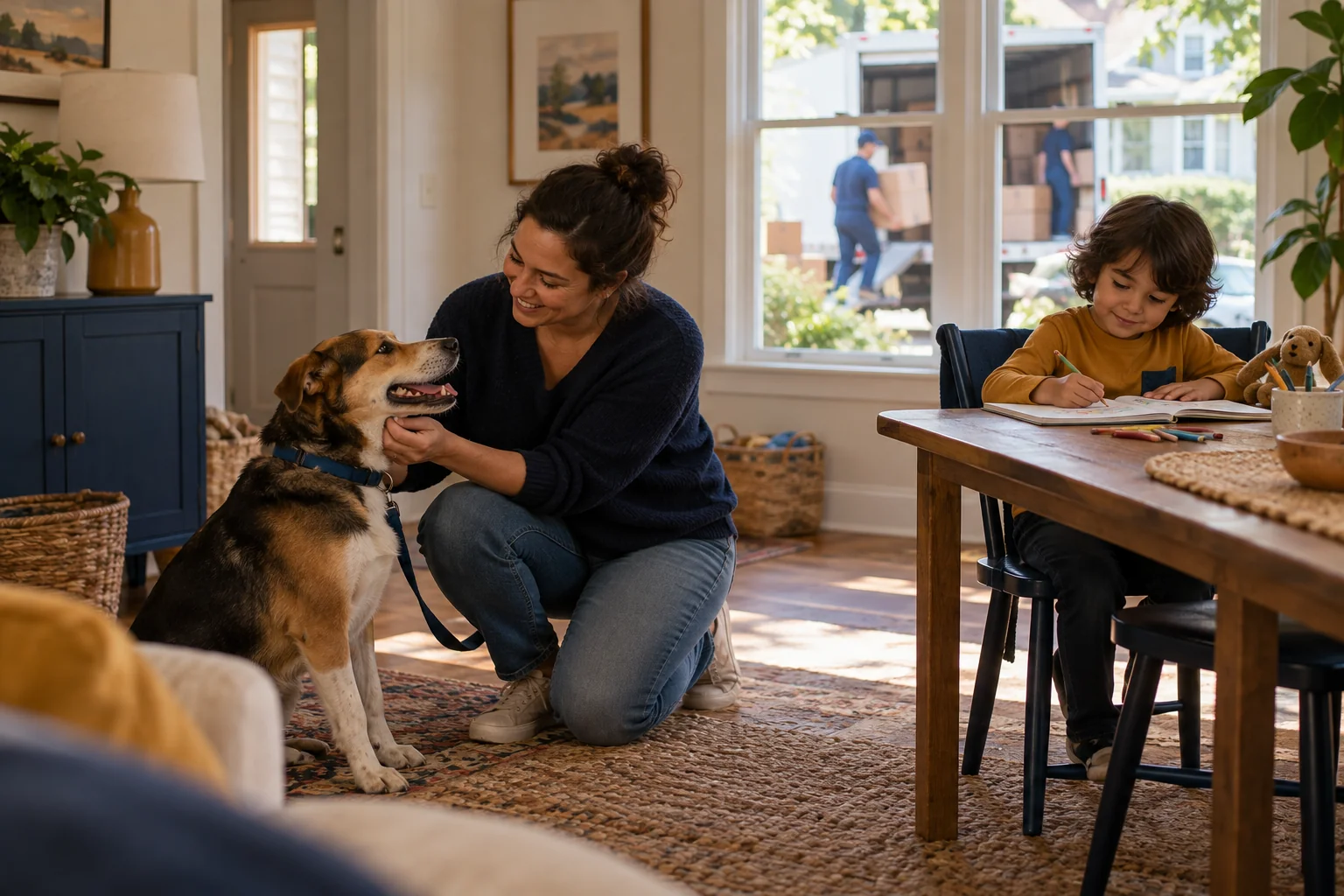
Moving day is a work site with open doors, heavy furniture, unfamiliar adults, vehicles, and a schedule that can change by the hour. A child or pet may need attention at exactly the moment a household member is asked to review documents or direct a crew. The safest practical plan gives care a named owner, a separate location, and a clear handoff before loading starts. It should not depend on a mover, friend, or older sibling noticing a problem while carrying boxes.
Begin by deciding where each child and pet will be during loading, travel, and unloading. The answer may be school, a trusted caregiver's home, a separate closed room with an attentive adult, a boarding service, or another arrangement suitable for the person or animal. Confirm the place and the hours. A vague promise that someone will “watch them” can fail when that person is also supposed to meet the truck or collect keys.
Put the care plan on the same timeline as the move but keep sensitive details private. The shared operational record needs the caregiver's name and contact, pickup and drop-off times, location, supplies, and backup. Medical details, school records, and private account information belong in secure channels with the caregiver or relevant professional. One adult should remain responsible for knowing where each child and animal is throughout the day.
Separate care from the loading route
Walk the origin home and identify where the crew will move. A hallway that looks quiet in the morning may become a dolly route. An open front door may stay open for long periods. A room chosen for a pet must remain secure even when people are moving furniture nearby. If there is no safe separate area, arrange care elsewhere before the truck arrives. Do not rely on a handwritten note on a door as the only barrier.
For children, choose an activity and supervision plan appropriate to age and needs. A school-age child may be comfortable with a trusted adult and a quiet place to read or draw. A toddler needs direct supervision and a secure area away from stairs, tools, and traffic. Older children may want to help, but give them limited tasks outside the crew's path rather than treating them as extra movers. Ask the child what they need to feel oriented, and keep familiar items accessible.
Pets may react differently to strangers, noise, and an open door. A carrier, leash, closed room, or approved off-site care can reduce the chance of an escape. Choose what is appropriate for the species and the animal's normal behavior. If the pet becomes distressed or has health needs, ask a veterinarian about the travel and care plan well before moving day. Do not experiment with medication or restraint methods on the day of the move.
Show the caregiver the boundaries of the care area and the expected moving route. Make sure the crew knows which door must stay closed and which items are not part of the shipment. A pet's crate or a child's travel bag should be clearly separated from cartons for the truck. The room-by-room move map can mark these as household-controlled items so a helpful packer does not load them by mistake.
Assign adults to jobs that can actually coexist
One person should handle the mover's questions and documents. Another may need to manage building access, parking, or the destination. A caregiver needs enough attention to supervise a child or pet. Do not assign all three roles to the same person unless the circumstances genuinely allow it. Write down who is responsible during each phase and where the handoff occurs.
If a trusted friend or relative will provide care, confirm the full time window, not only the expected truck arrival. Loading may finish late; travel may take longer; unloading may start at a different hour. Ask whether the caregiver can extend the time and what will happen if they cannot. Arrange a backup with a specific person or service that has agreed to help. “We will call someone” is not a tested fallback.
Give the caregiver practical authority. They should know how to contact the parent or owner, where supplies are, and what to do for ordinary needs. For a child, check pickup authorization and any rules at school or childcare. For a pet, share feeding, walking, and handling instructions. If the caregiver must enter a building, confirm access. A plan that names the right person but omits the key or gate code can fail before the move begins.
Compare care times with the parking and elevator reservation. The adult with the only building fob may need to stay for the full moving window. If that adult must leave for school pickup or a pet appointment, arrange another authorized access person or change the schedule. These conflicts are easier to solve when all appointments are on one calendar.
Prepare a separate kit for each child and pet
A child's moving-day bag should contain what they need before the first cartons are opened: suitable clothes, comfort items, food or snacks as appropriate, school materials if needed, a charged device or activity, and any essentials under the caregiver's control. Tailor it to the child's age and travel. Label the bag as traveling with the household. Ask the child what item matters most to keep close; a familiar blanket or toy can be more useful than another packed game.
For a pet, prepare the suitable carrier or restraint, water and a container, food for the travel period, cleanup supplies, bedding or a familiar item, and any necessary records or medication managed according to the veterinarian's advice. Check that identification and contact information are current. Keep the kit with the person transporting the animal, not in a random carton. Practice using a carrier in advance if the pet is unfamiliar with it; moving day is not a good first test.
If the move crosses a state or territory boundary, check the destination's animal-entry requirements early. The U.S. Department of Agriculture's state-to-state pet travel guide explains that requirements are set by the receiving state or territory and may include health documentation or vaccinations. It advises contacting a veterinarian once travel details are known. Rules vary, so use the destination's current requirements for the specific animal; do not assume a routine local veterinary record is sufficient.
Keep emergency contacts and the veterinarian's number accessible. Know how the pet will travel and whether the transport arrangement has rules about carriers, stops, or temperature. Ask the relevant carrier or service provider directly. Do not put a live animal in a household-goods moving truck. The pet's route should be planned as a separate part of the household's travel.
Make the departure handoff explicit
Before the crew arrives, confirm the caregiver is available and the child or pet has reached the planned location. Say who will call whom if loading runs late. If care is at the origin home, explain which door remains closed and who can enter. If care is off-site, confirm the pickup person and time. A text saying “all set” is useful, but the household should know what it means: the caregiver has the child or pet, supplies are present, and contact details work.
If a child will attend school that day, check dismissal and authorized pickup. The move may change which adult can arrive on time. Tell the school through its normal procedure if someone else will pick up. The parent directing the crew should not discover at dismissal time that the only approved pickup person is an hour away at the destination.
For a pet staying with a neighbor, agree on leash, carrier, and handoff rules. The neighbor may not know the animal's normal behavior. Tell them whether the pet can be handled by unfamiliar people, where it may go, and who will collect it. If a dog needs a walk during the moving window, ask the caregiver to plan a secure route away from trucks and open loading doors.
Photograph or record the contents of the care bag only if it helps with the handoff. A simple written list may be enough. Avoid sending private school, medical, or payment information through an insecure group chat. The caregiver needs the instructions that let them care for the child or animal, not every document in the household's moving file.
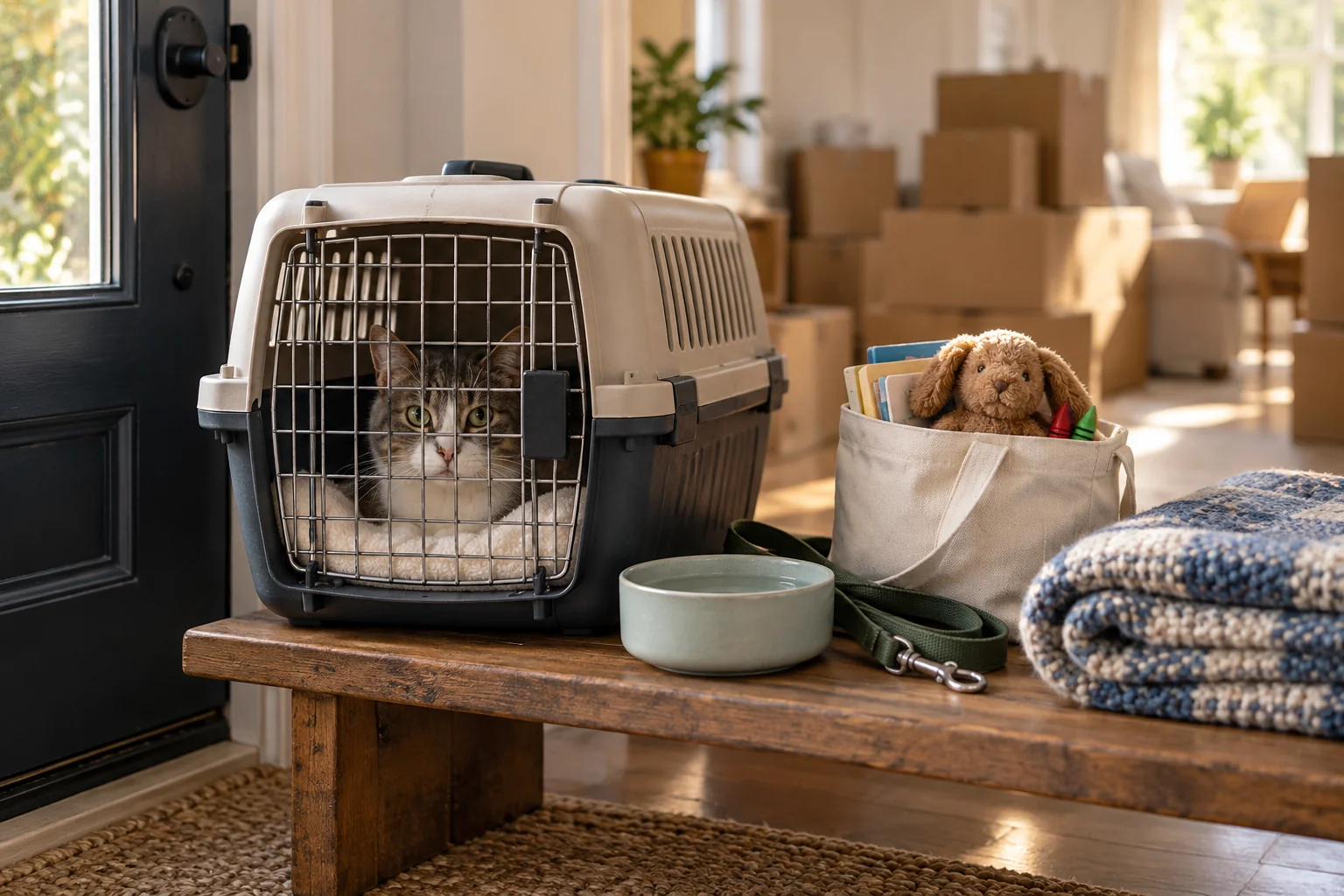
Plan travel between addresses
The travel phase is often a separate gap between loading and unloading. Decide who transports each child and pet, in which vehicle, and when they leave. A parent may need to stay at the old home for the final walk-through while another person drives to the destination to collect keys. If one vehicle carries essential supplies, make sure it does not leave before those supplies are ready. Keep the destination address and contact number with the person traveling, even if they normally rely on a phone app.
Allow time for ordinary breaks, traffic, and the needs of the traveler. A long trip with a child or animal may take longer than the mover's route. Do not promise that one adult can meet the truck at the destination at an exact hour if that adult is responsible for several stops. Arrange a destination contact or a suitable arrival range. If travel is disrupted, tell the mover and building contact promptly.
At the new home, choose a secure temporary place before doors are propped open for unloading. The space should not be on the crew's route or contain hazards left by setup work. If the new home is not ready for that arrangement, keep care off-site until unloading is finished. A pet carrier at the edge of a crowded entryway may be physically contained but still exposed to noise, traffic, or an accidental knock.
Check the destination room before using it for care. Remove packing tape, loose hardware, cleaning products, and tools. Make sure a window or balcony door cannot be opened accidentally. Confirm that the room has suitable temperature and water, and that the caregiver can reach a bathroom or exit without crossing the busiest lifting path. Put a plain notice on the door for the crew, but tell the crew verbally as well. If a child needs a quiet place and a pet needs a separate space, do not combine them simply because only one room is empty. The plan should fit the people and animals involved.
Introduce a child to the new space when there is enough calm attention to do it. A child may want to see their room, but that room might still be receiving furniture. An adult should decide when it is safe to enter and where the child can stay. Keep an immediate-use bag available for the first evening rather than depending on unpacking the correct box while everyone is tired.
Handle a change without losing track of care
If the mover is late, call the caregiver before their agreed end time and ask whether they can extend. If not, use the named backup or pause another task so a responsible adult can take over. Do not wait until the caregiver is already due to leave. Update the access person and mover if the change affects who can meet the crew.
If a pet escapes or a child is missing, stop the moving activity that could worsen the situation and follow the immediate safety plan appropriate to the circumstances. Assign one person to coordinate the response and keep others from creating conflicting searches or leaving doors open. The best prevention is the earlier separation of care from loading, but the household should still know who acts if that separation fails.
If a care provider cancels the night before, do not assume an unprepared adult can both supervise the child or pet and direct a complex move. Reassign moving roles, seek an available trusted alternative, or adjust the schedule. A rescheduled service may be inconvenient; an unsafe care arrangement is not a reasonable way to protect the original date.
Test the plan with a realistic household
Imagine two adults, a six-year-old child, a dog, and a cat moving between apartments. The truck will load from 8 a.m. to noon. The origin elevator is reserved until 1 p.m., and the destination slot begins at 2 p.m. One adult has the building fob and must speak with the crew. The other plans to drive the animals and child to the new home.
The household could arrange for the child to spend the loading period with a trusted relative, with pickup after the truck leaves. The dog could stay with that relative if the arrangement is suitable; the cat could remain in a secure carrier in a quiet room until the travel vehicle is ready. The adults need to decide who will verify the origin is empty and who will reach the destination first. If the driver with the animals is the only person able to unlock the new apartment, the destination crew may be waiting. A second authorized key holder or a changed travel order solves that dependency.
The care bags, carriers, and first-night essentials travel in the personal vehicle. The mover is told which area is off-limits and which items are not part of the shipment. The relative has the child's food, activity, pickup plan, and both adults' numbers. The cat's carrier is moved only when the loading door can be controlled. On arrival, one adult checks the new home's secure care area before bringing the animals inside. These are specific handoffs, not a general wish to “keep everyone safe.”
If the origin loading runs to 1 p.m., the household calls the relative and destination contact before departure. It does not silently compress travel time or abandon the final walk-through. The plan's strength is that each person knows which commitment moves and who must be told.
Close the care handoff after unloading
When the crew leaves, account for every child and pet and check that doors, gates, windows, and any temporary barriers are secure. Return borrowed carriers or supplies, pay or thank caregivers as agreed, and update them if a pickup time changed. Remove packed materials from the care area before letting children or animals explore it. Restore food, water, sleeping arrangements, and a normal routine as soon as practical.
Keep the first school or childcare day in view. A child may need an early bedtime and a bag that is easy to find. A pet may need quiet time and a familiar place away from unpacking. If behavior or health concerns arise, contact the relevant professional rather than guessing that every reaction is ordinary moving stress.
The care task is complete when the child or pet is safely with the responsible person at the destination, their immediate needs are available, and the caregiver handoff has ended. A moving plan that makes this visible protects the household's attention for the work that still remains, without asking a child or animal to adapt to the crew's schedule.
Plan for the hour the schedule slips
The care plan should cover a late truck or a longer-than-expected loading period. Give the caregiver a reachable primary contact and a backup, the expected pickup time, and permission boundaries for meals or transport. Pack the child's or pet's needed items outside the shipment. If a pet will travel by car, check its carrier, water, breaks, and destination access before the crew begins moving furniture. When the day changes, one household member should update the caregiver directly. A revised arrival time is useful only if the person responsible for care actually receives it.