
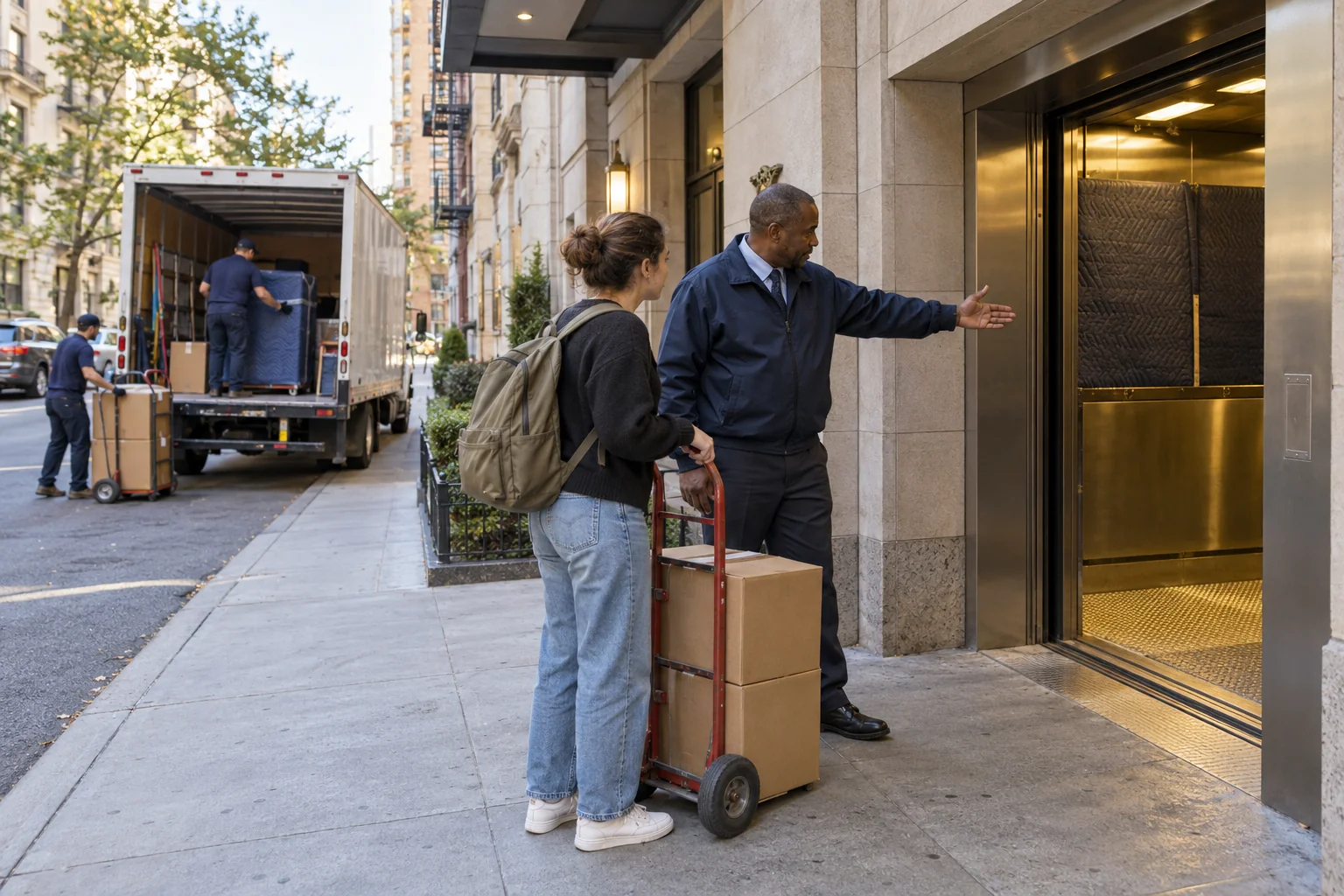
A moving truck can arrive at the correct address and still be unable to load. The building's service elevator may be reserved for someone else, the curb space may be restricted, or the crew may be waiting for a key holder. At the destination, a confirmed arrival window can collide with a short loading-dock reservation. Access is part of the move's schedule, not a detail to settle when the truck is already outside.
Plan the origin and destination separately. For each address, record where a vehicle may legally and practically stop, which entrance the crew will use, whether a loading dock or elevator must be reserved, who grants access, and the hours when work is permitted. Ask the property manager, owner, local authority, and mover as appropriate. Requirements vary by building and locality, so a neighbor's move or an old online post is not a reliable substitute for a current answer.
Attach each confirmation to the household's main moving plan. “Parking arranged” should mean a specific space or permit, a valid time, the vehicle it covers, and a person who can resolve a problem. “Elevator booked” should mean an accepted reservation for the right building and date, with any required protection or deposit understood. The finish condition should tell another household member what to do without making another round of calls.
Start with the vehicle and the route
Ask the mover or rental provider what vehicle is expected, including approximate size and any requirements that affect access. A building may have limits on truck height, weight, or where loading is allowed. A narrow street or low clearance can change the approach. A parking space that fits a passenger car does not necessarily fit a moving truck. If the vehicle is not yet known, record the uncertainty and ask how the provider handles restricted access.
Walk the route from the lawful stopping place to the front door or service entrance. Note stairs, ramps, gates, uneven surfaces, narrow turns, and the distance items will be carried. Photograph obstacles and share relevant details with the mover before the estimate is final. Long carries or difficult access may affect labor or service. The household should ask about the cost and method rather than assuming the crew will improvise.
At the destination, repeat the walk from the truck to each room. A loading dock may lead to a freight elevator but not directly to the apartment floor. A service entrance may require a fob or escort. An accessible entrance may have rules that differ from the loading route. Check whether the route is available for the whole move, not only for the first person entering.
Do not plan to block a fire lane, sidewalk, driveway, or another tenant's access. Ask the relevant authority about lawful parking and permits. If a permit is required, note who obtains it, where it must be displayed, and its valid period. If no reserved truck space is available, discuss a practical alternative with the mover and account for the extra time or cost. A plan based on “there is usually a spot” needs a fallback.
Parking questions should be specific to the side of the street and the hours. A curb may be available for loading but restricted during a morning rush period. A space may require a temporary sign installed by a local agency in advance. A private loading dock may be accessible only through a gate that an attendant opens. Ask about these details when the date is known, then check the current instructions again shortly before the move. Record the authority's answer rather than assuming that a generic permit found online applies to your vehicle or block.
If a truck must park farther away, tell the crew how long the carry is and what surfaces are between the vehicle and door. A long walk can change the time required for every carton. A steep ramp, gravel path, or several stairs may make a loaded dolly impractical. The mover can decide what equipment and labor it needs once it has an accurate description. A self-managed move should similarly arrange capable help and equipment for the actual route, not only the weight of the furniture.
Understand building rules before booking the window
Contact both buildings or associations early. Ask about moving hours, notice periods, elevator reservations, loading docks, protective padding, certificates or insurance documentation, deposits, and any limits on weekends or holidays. The rules can be different at the origin and destination. Write down who gave the answer and where the formal instructions can be found. If the manager sends a form, complete it and retain the accepted response.
An elevator request is not a reservation until the building confirms it. Ask for the exact start and end times, whether setup and padding are included in the slot, and what happens if the truck arrives late. Some buildings may allow a single move at a time; others may share an elevator with residents. Do not assume the crew can use a passenger elevator if the service one is unavailable. Clarify the allowed route.
If a building requires mover documentation, tell the company promptly and check that the document names the correct property and date. Do not invent or fill in insurance details yourself. The mover and building should resolve their requirements directly when possible, with the household tracking the deadline and confirmation. A missing document can stop the elevator even when the truck is parked and the cartons are ready.
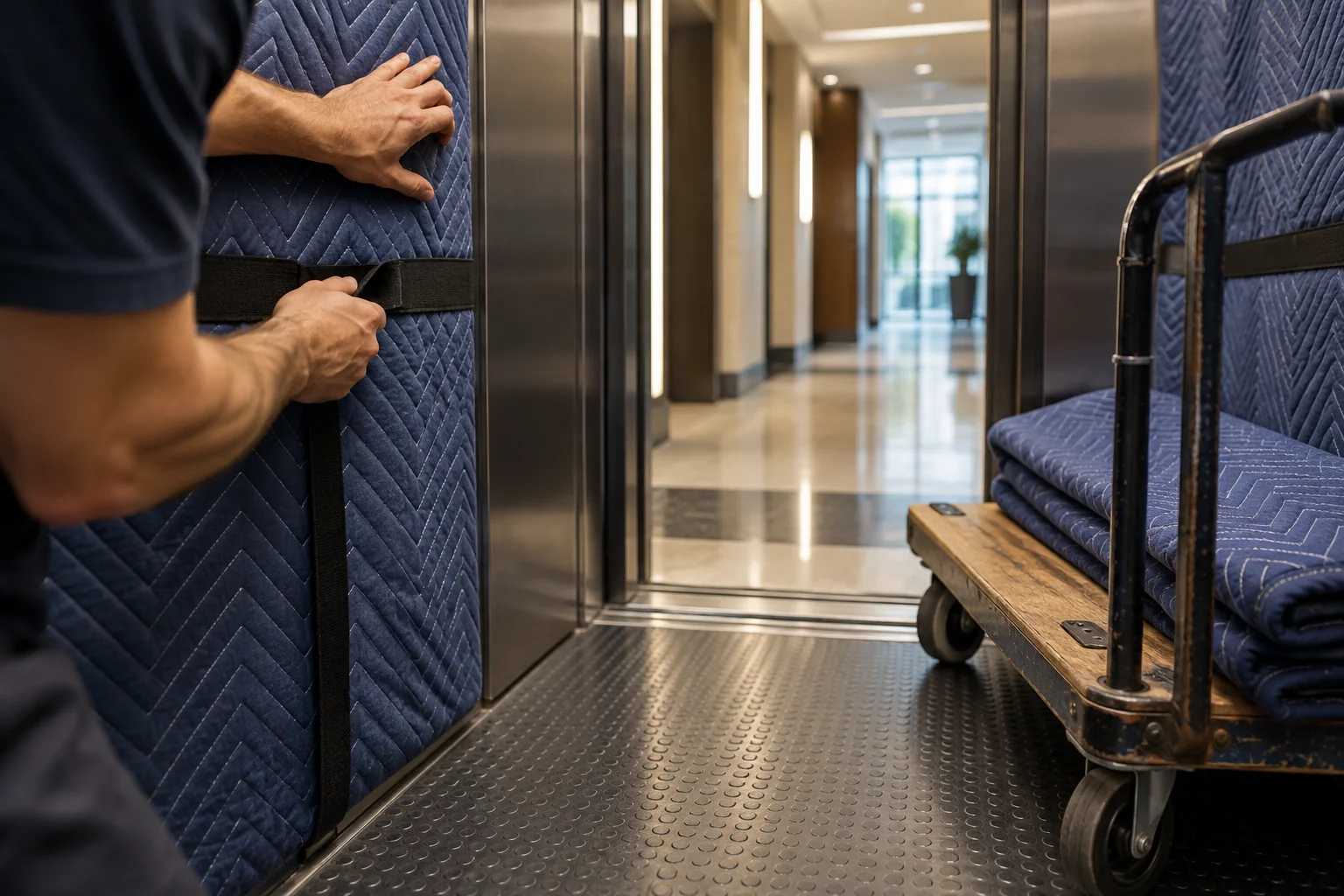
Plan how the elevator will be used, not only when it is reserved. Large pieces may need a separate trip. Cartons may be staged near the elevator only where the building allows it. A crew may need time to pad walls and doors before the first load and to remove protection after the last. Ask whether the reservation window includes this setup and cleanup. If the building shares the elevator with residents, the move may proceed more slowly than a private freight-elevator booking. A realistic schedule leaves room for that difference.
Where the elevator is small, measure the clear door and interior dimensions for the largest item. Compare them with furniture measurements before moving day. A bookcase that fits the apartment but not the elevator may require disassembly or a different lawful route. Tell the mover about the tight dimensions. The household should not promise that a piece can go through based on a rough visual guess.
Ask about keys, access cards, codes, and door control. The person with the only fob may need to remain at the entrance while another person directs unloading upstairs. A temporary access card may be available, or the building may require an attendant. Decide who will handle this operational role and confirm they will be present for the full window.
Match access time to the mover's real schedule
Compare the mover's pickup and delivery windows with each reservation. A mover's arrival range is not the same as the time the elevator will be used. Loading may require several trips, and unloading may begin after travel, check-in, or paperwork. Ask the company for a realistic sequence and tell it about the building's fixed end time. Keep the written response with the building confirmation.
For an interstate household-goods move, the Federal Motor Carrier Safety Administration's moving checklist advises asking how and when pickup and delivery will occur and how to contact the mover before, during, and after the move. Access questions belong in that conversation. Local moves may follow different state rules, but a household still needs compatible service and building windows.
Do not reserve a narrow slot that works only if every earlier step goes perfectly. Account for crew check-in, padding, a walk-through, elevator travel, and the number of large pieces. If the building offers only a short window, tell the mover before agreeing to it and ask whether the planned work is feasible. A larger crew or different arrival time may be needed; any change should be confirmed in the service arrangement.
At the destination, check possession time. An elevator slot at 9 a.m. is unusable if keys are not available until noon. Similarly, a person assigned to meet the truck must be able to reach the destination before the crew. Compare school pickup, work shifts, travel, and care arrangements in the school and work schedule plan. Access is a people dependency as much as a building reservation.
Give every party the same instructions
The mover needs the correct building entrance, stopping location, reservation time, contact person, and any restriction on vehicle size or equipment. The building needs the mover's name and required documentation, the move date, and the household contact. The person meeting the crew needs both sets of instructions. Put the current version in one shared record and send a concise confirmation to each party.
Use exact addresses, including unit numbers and loading entrances. “Back door” may be clear to a resident but not to a driver on an unfamiliar street. A map pin or photograph can help where several entrances look alike, but confirm with the building that the pictured route is permitted. If access instructions include a security code, share it only through a suitable channel with people authorized to use it.
Assign one person to monitor the mover's arrival and one to handle building access if the locations or roles require it. They can be the same person only if the tasks genuinely fit together. The person directing a crew upstairs may not hear the building manager call from the loading dock. Provide a backup number in case the primary contact loses service or must leave briefly.
Check whether a property manager needs notice when the truck arrives. If an attendant will open the dock or elevator, confirm their working hours and contact channel. A confirmation from an office that closes before the move begins may not solve a problem on the day. Ask who can make a decision if the reserved space is occupied.
Prepare for the predictable failure points
Parking can be occupied despite a reservation. Ask what evidence or signage the authority requires and whom to call if the space is blocked. Do not move someone else's vehicle or direct the truck into a prohibited area. The fallback might be another lawful space, a later slot, or a different loading method agreed with the mover. Put a realistic contact and decision owner beside that fallback.
An elevator can fail or a previous move can run late. Ask the building whether another elevator is allowed and what happens to the reservation. If the answer is “no alternative,” understand how much delay the mover can absorb and what charges or rescheduling terms might apply. This conversation is easier before signing a service agreement than while a crew waits in the lobby.
Make a short escalation order for the person on site. If the dock is blocked, call the building contact first, then the mover's dispatcher if the unloading plan must change. If the elevator stops, ask the building for a safe alternative and tell the crew what has been authorized. If the crew is late, ask the mover for an updated arrival range and then contact the building about extending or changing the slot. This order avoids three people making conflicting promises. Record any new window in the shared plan and send it to the other address if the schedule there is affected.
Weather can slow a long carry or make a loading path unsafe. Think about covered routes, floor protection, and where cartons can wait without blocking exits. Do not treat a public sidewalk or shared hallway as storage. If a storm would make a route unsafe, the household and mover need a way to communicate and decide on a revised plan.
The vehicle itself may differ from what was expected. A larger truck might not fit the loading dock; a smaller shuttle may be needed. Ask the mover how it handles restricted properties and whether a different vehicle or extra labor changes the price. For a rental move, confirm vehicle dimensions before the pickup day and choose a legal approach route. A truck reservation alone does not establish that the truck can reach the home.
Walk through a two-building example
Suppose an apartment household has reserved the origin service elevator from 8 a.m. to noon. The mover's pickup window is 9 to 11 a.m. The destination building allows unloading from 1 to 4 p.m., but its loading dock requires the mover's insurance document two business days ahead. The drive is about 45 minutes in ordinary traffic.
The calendar looks possible until the sequence is tested. If the truck arrives at 11, there may be only an hour of origin elevator time. Loading could overrun the noon deadline, and the destination slot might begin before the crew reaches it. The household should ask the mover whether the late arrival is compatible with the origin reservation, request a narrower or earlier arrival window if available, and ask both buildings about longer or alternative slots. It must submit the destination document by the building's deadline.
Now add a child who must be picked up from school at 3 p.m. If the adult with the destination fob leaves the building at 2:45, the crew could lose access before the 4 p.m. slot ends. The household can assign an authorized second adult to stay, arrange an approved school pickup, or choose another slot. Each solution needs the other party's acceptance. Writing “elevator 1–4” without assigning the fob holder would conceal the conflict.
If a child or pet will be near the active loading route, use the moving-day care plan to give them a separate supervised location. That care arrangement also determines which adult can remain at the elevator or truck for the full reservation.
The final plan records the origin and destination windows, document acceptance, mover arrival agreement, stopping places, and names of the adults at each address. On moving day, a person can open that record and call the right contact when a truck is delayed. That is the practical value of planning access.
Recheck before the truck arrives
In the final week, reconfirm the reservation, permit, required documentation, keys, and contacts. Compare them with the mover's latest schedule and vehicle information. If a date or arrival window changed, ask each affected party to confirm the revised arrangement. Do not assume one email sent to the mover has changed a building reservation.
The day before, walk the route if possible. Clear household items from hallways, stage cartons where permitted, and separate essentials that must not be loaded. Verify the door or gate that will be used and the location of any protective equipment. A building may supply elevator padding, while another expects the mover to bring it. Resolve that before loading begins.
At the start of the move, have the access contact meet the crew and point out the route. Watch for new obstacles or restrictions. If the plan no longer fits, make a deliberate decision with the mover and property manager rather than asking people to force a large item through a blocked or prohibited path. Keep the timing and any agreed change in the moving record.
After unloading, check the route for damage or left-behind equipment and return keys or access cards under the building's rules. Confirm whether a deposit will be returned and retain any receipt. The access task is complete when the truck has left lawfully, the building's requirements have been met, and the household has no unresolved handoff with the manager or mover.