

An unloaded home can look equally unfinished in every room. The temptation is to open whatever carton is closest, put a few objects away, and move to the next box. By evening, the household has more open cartons, less floor space, and no clear answer about what is still packed. A priority system makes the home usable in stages while preserving the item trail created during delivery.
Start with what people must do in the next twenty-four hours: sleep, wash, take medication, feed people and pets, charge devices, and use the bathroom safely. Then identify the functions needed during the first week, such as work, school, laundry, and ordinary cooking. Decorative and rarely used goods can wait. The goal is not to finish the house quickly; it is to make each opened carton solve a real need and to know where everything else remains.
Keep the delivery inventory and room register accessible. An item marked received may still be in the wrong room or inside an unopened carton. If something appears absent as you unpack, use the guide to triaging missing or damaged items after delivery to distinguish a search from a damage record or a claim. Do not throw away labels and packing before the household has confirmed the contents of a suspect box.
Make the first night functional
Choose one sleeping area for each person before opening general cartons. Find bedding, pillows, a change of clothes, and any equipment needed for the bed. If the frame is not ready, a safe temporary sleep setup may be better than a late-night assembly attempt. Keep walkways and exits clear. Children and pets may need a calm room away from sharp tools, stacked boxes, and open exterior doors.
Set up the bathroom early. Locate toilet paper, soap, towels, shower supplies, basic cleaning materials, and a trash bag. Check that water, lights, and locks work. A bathroom carton should not be buried behind books or furniture hardware. If the household carries medication or medical supplies, keep them with the person responsible for them and place them in appropriate storage as soon as the home is secure. Do not mix them into a communal “miscellaneous” box.
Create a modest food and drink station. It may be only water, a kettle or coffeemaker if safe to use, a few plates and utensils, and easy food. Check the refrigerator and stove before relying on them. If a gas appliance, electrical outlet, or water connection appears unsafe, stop and contact the appropriate provider or qualified professional. Do not make dinner depend on unpacking the entire kitchen.
Charge phones and keep the contact sheet handy. Set aside keys, wallets, identity documents, work devices, and the move paperwork in one secure place. Those objects are easy to misplace among open cartons, and the household may need them the next morning. A tray or pouch that stays with one adult works better than a “safe spot” that changes every hour.
Decide what to open next
Use a three-level priority list. First are immediate needs: sleep, hygiene, medicine, food, and safe access. Second are routines that resume within a week: clothing, school materials, work equipment, laundry, cookware, and pet routines. Third are items with no near-term use: seasonal decor, extra books, display pieces, and duplicates. Assign a rough day or weekend to each group rather than treating every carton as urgent.
Within a room, open boxes that enable another task. Bed linens matter before a decorative throw; the basic pan matters before the complete serving set. A desk chair and laptop power supply may matter before filing old papers. This dependency-based order prevents the household from spending an hour arranging a shelf while the bed remains unusable. Put the next two or three useful boxes where they can be reached and leave the rest sealed for now.
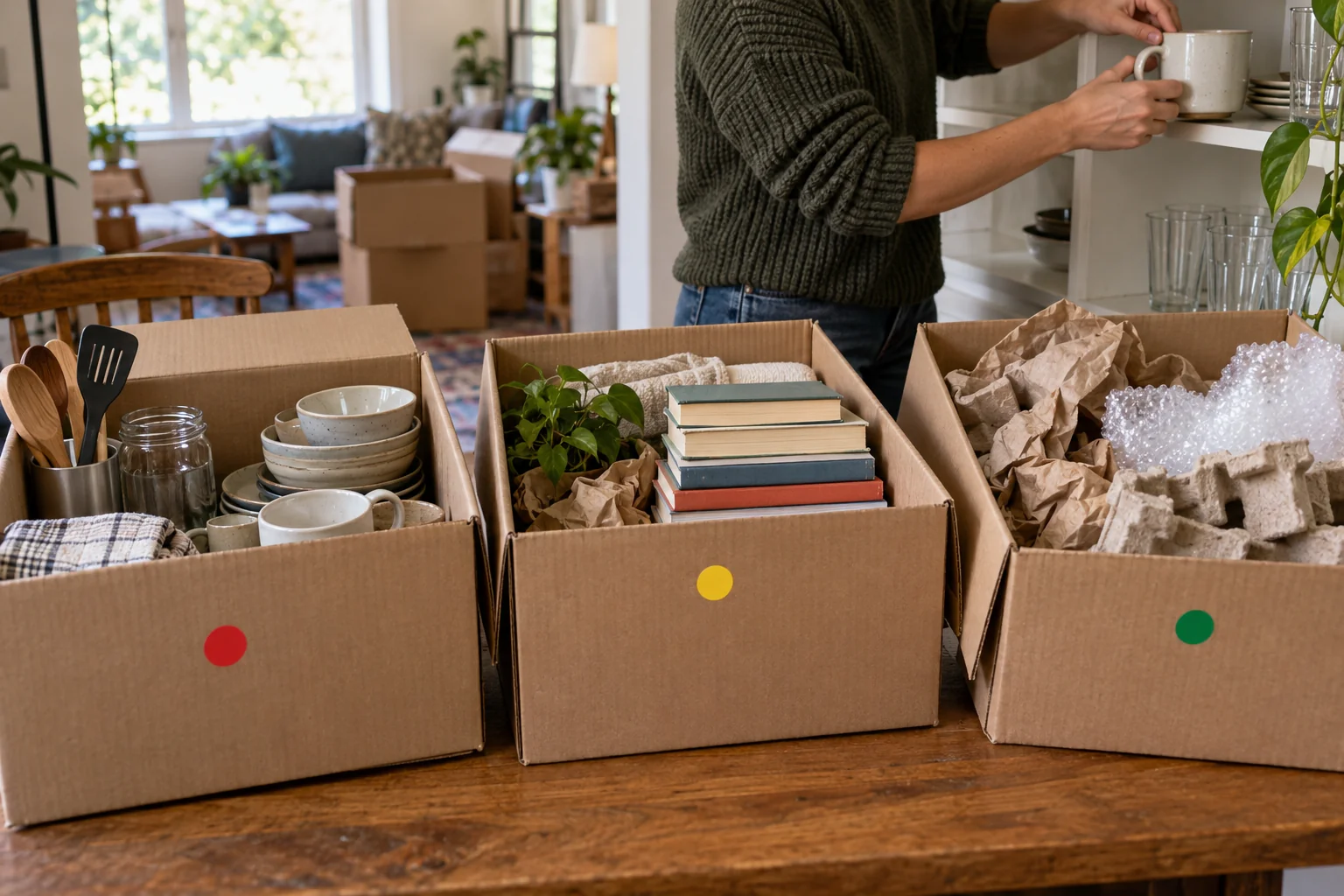
Do not let the color of a label become the only source of truth. Room codes tell you where a box belongs, not how soon its contents are needed. A kitchen box may contain daily plates or holiday dishes. Use the content summary or household register to find the useful carton. If the labels are vague, open one box at a time, identify it, and update the register before opening another of the same type.
Priorities can differ by household. A person working from home may need internet and a quiet desk before unpacking the dining room. A baby may need feeding and sleep supplies in the first hour. A pet may need a familiar bed, water, and a secure room. A person with limited mobility may need clear routes and accessible equipment before almost anything else. Write the specific household needs at the top of the list so a generic “kitchen first” rule does not override them.
Keep a record as cartons open
Mark each box with a simple status: sealed and located, open in progress, contents checked, or empty and cleared. Record its actual room if it moved from the delivery location. A paper list, shared note, or photo of the label next to the unpacked contents can work. The important rule is that a box is not “done” merely because its tape was cut. Check the contents, note any concern, and decide where they belong.
Open one carton in a working area that has enough space for its contents. Keep the carton label visible until you verify what was inside. If you move objects into drawers or shelves, make a brief location note for high-value or easily lost items. You do not need to inventory every fork, but you should know whether a document folder, appliance part, or set of fragile pieces has been found.
If an item belongs in a different room, carry the item or make a small transfer bin. Do not casually carry a half-open carton through the house and leave it somewhere without updating its location. That is how “missing” items become placement puzzles. A transfer bin should be emptied at the end of a session; otherwise it becomes an untracked fourth category of possessions.
Make a short list of incomplete sets. Record “desk assembled except two drawer pulls” or “six dining chairs found, leaf still boxed.” This gives the household a concrete next search. A set can be partly usable while the missing component remains open. Keep hardware bags with the parent piece, not in a general jar where every screw from the move is mixed together.
At the end of each unpacking block, update the room list and close empty cartons. A ten-minute reset keeps floor space usable and prevents repeat searches. Decide which boxes will be opened next; do not leave a dozen partly unpacked cartons as invitations for everyone to start a different task.
Inspect condition without turning unpacking into a claims hunt
Look at fragile and high-consequence items early enough to identify a problem while packing remains available. Electronics, ceramics, glass, artwork, and furniture parts may merit a focused inspection. Photograph a damaged item in context with its label and packing before discarding material. Keep the issue separate from ordinary unpacking notes so the household can follow it through with the right provider.
Do not assume every scratch is new or every broken item was harmed in transit. Compare condition with pickup records and pre-move photos when available. Record what you can observe and when you found it. If a carton is visibly crushed or wet, set it aside for careful inspection rather than burying it beneath other boxes. If there is leaking liquid or broken glass, make the area safe before documenting it.
For items delivered by a professional mover, check the agreement and claim process for time-sensitive steps. The Federal Motor Carrier Safety Administration's consumer guidance for interstate moves recommends listing damaged and missing goods, photographing damage, and contacting the mover promptly. That guidance does not replace the terms for a local mover, storage provider, rental truck, or separate shipment. Record which route handled the item before choosing whom to contact.
Keep packaging for a potential inspection or return when practical. You can flatten ordinary empty cartons whose contents are confirmed, but do not discard a damaged custom crate or labeled packing around a disputed item prematurely. Store retained materials in a designated place so they do not create a hazard or block a room. Label that place with the associated item record.
Handle heavy and awkward objects at the right time
Some unpacking is really installation. A tall bookcase, large bed, wall-mounted television, or appliance may require tools, a second person, a professional, or property permission. Do not put books on an unsecured tall shelf just to empty cartons. Check the manufacturer's instructions and the wall or floor conditions before anchoring or loading furniture. The guide to reassembling and checking furniture safely can be used for pieces that were taken apart for transport.
Schedule heavy assembly when people are rested and the space is clear. Keep tools and small parts away from children and pets. Match each hardware bag to its item before opening it. If a part is missing or a frame is damaged, stop rather than forcing a substitute part. An unstable temporary setup can make a room less usable than a sealed carton.
Measure before placing furniture permanently. A sofa that blocks a vent, outlet, door swing, or emergency route may have to be moved again. Leave enough space to continue unpacking and carrying other items through the room. The first position is a working position; the household can refine the layout after the essential functions are in place.
If a service provider is scheduled to assemble furniture, confirm the date, scope, and what the household must have ready. Keep the item, hardware, instructions, and access path together. Do not bury a needed part in a carton labeled for a different room. Note completion and any unresolved issue on the household task board after the provider leaves.
Keep the space livable as work continues
Create three clearly separated destinations for empty packing: reusable materials, recycling or disposal under local rules, and materials being retained for an open issue. Break down empty boxes only after their contents are checked. Avoid large stacks near exits or heaters. A small regular cleanup is more effective than a giant pile that must be handled at the end of the month.
Do not let the desire to clear boxes push unneeded items into the nearest drawer. That creates a second move inside the new home. When a thing has no clear destination, decide whether to keep it in a labeled temporary zone, donate or sell it later, or revisit the room layout. Record a specific decision date. A permanent “miscellaneous” closet fills quickly and hides items that the household may later assume are missing.
Protect a quiet, usable area from the unpacking project. A cleared table, made bed, and safe bathroom let people recover between work sessions. This is particularly valuable when children, older adults, or pets are adjusting to the new space. The home does not need to look finished to function. Avoid pushing boxes into that one good area every time another room becomes inconvenient.
Set a realistic pace. A family can work in short sessions organized by function: bathroom and sleep tonight, breakfast and work stations tomorrow, laundry and school supplies next, then storage and decor. Stop before fatigue turns simple decisions into mistakes. A labeled sealed carton is often better than an open carton whose contents were scattered because someone was too tired to finish it.
Follow a first-week example
Imagine a household arriving on Friday evening with two adults, a child, and a dog. The truck has delivered most goods, while one specialty item will arrive Tuesday. The family brings in its personal overnight bags, confirms that the dog has water and a secure room, and sets up one bathroom. One adult makes the beds. The other opens the kitchen essentials tote for breakfast. They leave the boxes of books and decorations sealed.
On Saturday, they check the room register. The child's school bag, two work monitors, and laundry supplies become the next priorities. They open the relevant cartons one at a time and mark their contents checked. A monitor stand is not in the same carton as the screen; the register shows it with desk hardware, so they find it without opening every office box. They keep the carton labels until the setup works.
On Sunday, the family opens a kitchen carton and discovers a chipped bowl. They photograph it with the carton and packing, make an issue entry, and set the material aside. They do not stop all unpacking to debate its value. They finish the kitchen function, then contact the appropriate mover through its documented process. The issue has an owner and next step while the home continues to become usable.
By midweek, the specialty item arrives. The family checks that route separately and updates the household list. Several decor cartons are still sealed, which is acceptable because the immediate and weekly functions are working. They know where those cartons are and have a plan to open them. The absence of scattered open boxes makes the unfinished work visible and manageable.
Finish with a controlled handoff to normal life
Before retiring a carton from the active list, check that its contents are actually usable. A set of dishes may be counted but still need washing; a printer may be present but need a power cord; winter coats may be hung but inaccessible behind a blocked closet door. Mark the remaining action rather than keeping the entire box vaguely “in progress.” This creates small, finishable tasks and makes it clear when a room's basic function is complete.
For a shared household, hold a brief review at the end of the day. Each person can report which boxes were opened, where an item was moved, and what issue needs another person's help. Keep the record factual and short. The point is to prevent two people from searching for a thing that one has already put away, or from discarding packaging another person was retaining for a claim. A five-minute handoff can save a long search the next morning.
At the end of the first week, review the remaining sealed cartons by room and priority. Check whether any box is in the wrong place, whether a needed component remains unresolved, and whether an open issue has a follow-up date. Move empty packing out of living areas. Do not mark the whole move complete merely because the floor is visible; there may still be a service appointment, claim, or storage route to close.
When each box is opened, verified, and either put away or assigned a known temporary location, retire its entry from the active unpacking list. Keep a short list of remaining household tasks. The system can be simple because its purpose is simple: people can use the home now, find what they need later, and explain the status of anything still missing, damaged, or waiting in a sealed carton.
Keep a small exception area
Choose one surface or corner for cartons that cannot be closed out during unpacking. A box may contain a missing hardware bag, an item intended for storage, or something that arrived damaged. Mark the carton number and next action before moving on. Do not mix these with ordinary recycling or empty boxes. At the end of each day, check whether an exception needs a photograph, provider notice, replacement part, or simply a new room assignment. That small practice lets the household make progress without losing the facts needed for a later claim or repair.