
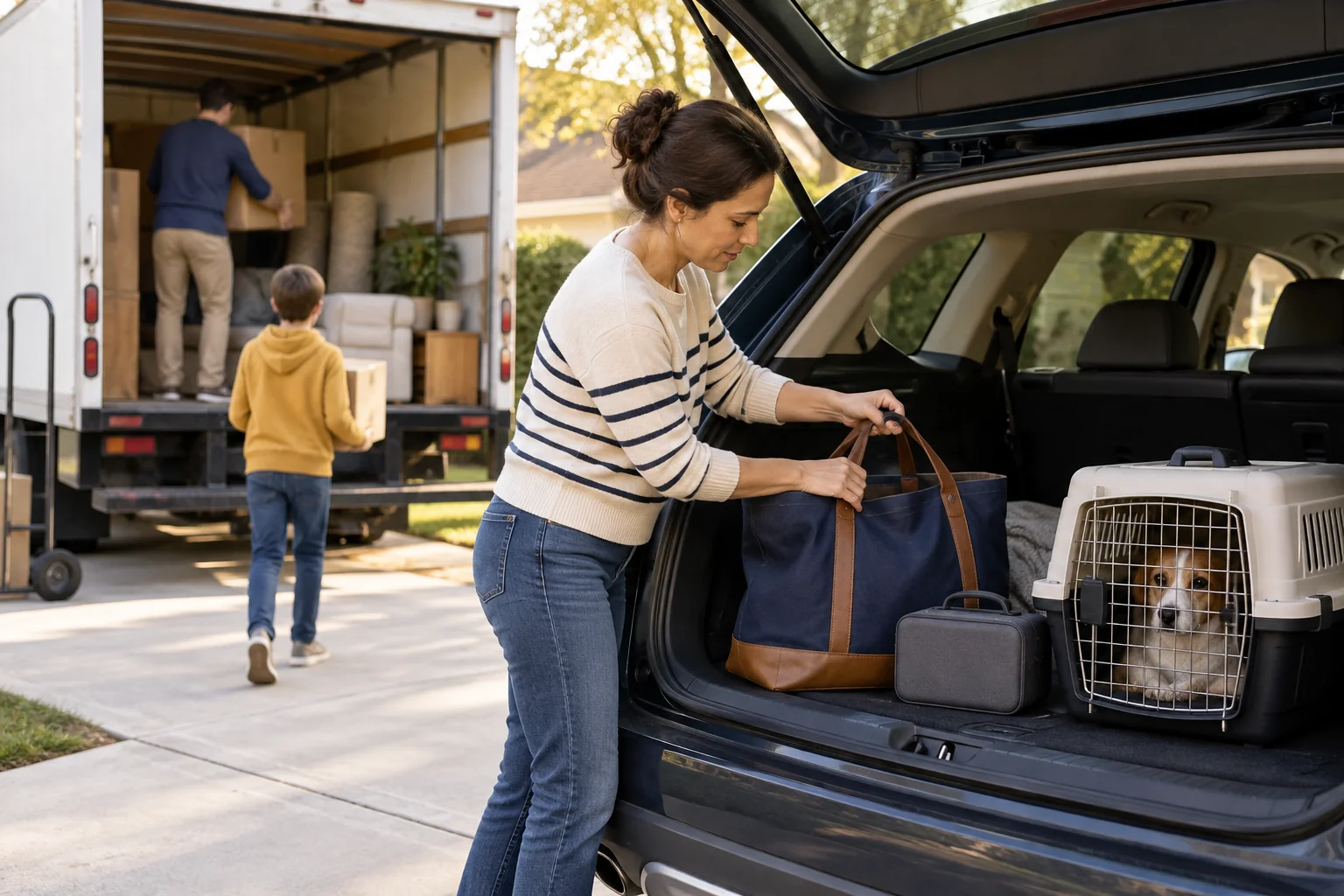
Not everything leaving a home follows the main moving truck. A car may carry medication and documents. A storage unit may receive some furniture. A fragile instrument may travel with a specialist, and a relative may collect a few boxes. When these routes are not recorded, the destination household may search the wrong shipment for a missing item or assume someone else has it. A separate-route list makes each handoff visible from origin to final location.
Start with the pickup inventory. It should describe what the mover actually accepted, while the household's own register covers everything being relocated. The guide to checking the inventory at pickup explains how to reconcile those two records. For every item that is not on the main truck, give it a destination, a carrier or custodian, a departure time, and an expected arrival or storage location. A simple line can answer who last had it.
Use routes rather than a vague “not with movers” pile. Common routes are household vehicle, storage stop, second professional service, friend or family vehicle, shipment by a separate carrier, donation, or an item staying behind. If a thing is being donated, it should not be counted as expected at the new home. If it is going to storage, it has not reached its final household room. Distinguishing these outcomes prevents a false missing-item report.
Give each route an owner
Name the person responsible for each separate route. “In our car” is not enough if two adults drive different vehicles and one leaves earlier. Write “Adult A carries document pouch and laptop in car 1” or “Adult B transports pet supplies in car 2.” If someone else takes custody, record their name, contact, and what they agreed to deliver. Ask them to confirm the handoff when it happens.
Keep the list small enough to maintain. You need item categories and unique identifiers for important pieces, not an inventory of every pen inside a travel bag. A line for a document case, a medical equipment bag, a pet carrier, and a first-night tote may be enough. For a specialty item, include identifying photographs and any protective or handling instructions. Do not write sensitive account numbers or medical details into a shared route list.
Check that each vehicle can carry its assigned load safely. Passenger space, pet restraint, visibility, and the driver's ability to operate the vehicle matter more than squeezing in one more carton. If a vehicle is overloaded, move ordinary items back to the main shipment when the provider accepts them or arrange another lawful route. Do not put fragile goods where they can fall onto a passenger or pet. A personal car is a good place for critical items only when they can be secured and reached as needed.
The owner should know whether an item may be left in an unattended vehicle. Documents, laptops, medication, and temperature-sensitive items may need to stay with a person during stops. Plan how to carry them through a hotel, meal stop, or key handoff. A bag that is easy to identify from outside a parked car may invite theft. Keep the travel kit discreet and within the household's control without hiding something so well that the responsible person forgets it.
Personal travel items need direct custody. Medication, identity documents, keys, payment methods, and essential devices should not sit beside cartons awaiting the crew. Put them into the assigned person's bag or vehicle before loading begins. The person who owns that route checks the items again before departure and at arrival. A “do not load” label is weaker than a closed vehicle or clearly restricted area.
If a route involves a friend, make the agreement specific: which boxes, pickup time, destination, access instructions, and who receives them. A generous offer to “take a few things” can change when the friend's car fills or schedule slips. Do not place an essential item on that route without a backup. Keep the friend's phone number on the household contact sheet if the move depends on the delivery.
If the friend is transporting someone else's belongings, agree on the handoff before departure. Should they leave the cartons at the front door, wait for a named adult, or place them in a locked room? An unattended delivery may create a new loss risk. Confirm the destination can accept the items at the planned time. If the friend cannot arrive until after the household leaves, choose a secure alternative rather than assuming a porch will be safe.
Separate storage from final delivery
Storage is a handoff, not a destination room. List the facility, unit, access hours, who has the key or code, and which items will be placed there. Mark each storage carton with a storage destination code visible on more than one side. If a professional mover handles the stop, confirm it appears in the written service scope and inventory. If the household drives the items itself, maintain a separate count and check it at the unit.
At the unit, record what actually went inside. A photograph of the arrangement can help find a box later, but do not rely on one wide image to identify every carton. Keep a short list of item IDs or categories and note what is near the front. If someone else will retrieve an item, make sure they have lawful access and know where it is. A box marked “first week” is of little use if it sits behind heavy furniture in a unit that closes early.
Protect access credentials separately from the stored goods. A key or lock combination should be with an authorized person, not sealed inside a carton in the unit. If the facility uses an account login, verify that the responsible adult can access it after changing phones or addresses. Note the facility's closing time and any appointment needed for a large vehicle. The storage route is complete only when the items are placed, the unit is secure, and someone can retrieve them later.
If storage is temporary, add a retrieval date or trigger. The household may expect to bring winter clothing, tools, or archived papers into the new home later. Put that task on the move plan. Otherwise, the item can remain absent from the household for months while everyone assumes it will “come later.” Record any second carrier or vehicle that will complete the route.
At each storage handoff, compare the list with what the receiving person sees. If a provider hands over three numbered cartons and a chair, acknowledge those items specifically. Do not sign an ambiguous “all received” note if the list shows more. Preserve the storage agreement and receipts separately from the mover's documents so questions go to the right provider.
Handle special transport with clear boundaries
Some items may need a separate provider or method because of size, fragility, value, legal restrictions, or the main mover's policy. Discuss those items before moving day. A piano, plant collection, artwork, vehicle, or equipment with batteries may have requirements that a general truck booking does not cover. Ask the relevant provider what it will accept, how it will pack or secure the item, and what documents or coverage apply. Do not improvise transport for an item simply because the main mover declined it.
Keep the specialty provider's confirmation with the route list: item, pickup and delivery addresses, dates, contact, price, and any access requirement. If the item will arrive after the household, make space and receiving arrangements. A large instrument cannot be placed safely if the designated room is full of boxes. Tell the destination lead what is coming and who will handle it.
If a separate shipping service is used for a small item, record the actual tracking number and delivery address in the private move file. Be careful with address timing: a package sent to the new home before keys are released may be lost or returned. Ask who can receive it and whether delivery is permitted. Do not publish tracking numbers or private addresses on a general helper sheet.
Check provider rules for items that cannot go on the moving truck. The household may need to use, donate, or dispose of them under local rules rather than transport them separately. Do not label a prohibited item as a personal-car item without deciding whether that method is safe and lawful. The separate-route list is a tracking tool, not permission to carry anything by any vehicle.
Keep custody records practical
A route list can have columns for item or group, identifier, origin, person or provider, destination, departure, expected arrival, actual handoff, and open issue. Use a shared file for ordinary items and a private note for sensitive ones. Add a status such as prepared, handed off, in transit, in storage, received, or canceled. Only mark “received” when someone at the destination confirms it.
Photographs are useful for identifiable high-value or fragile pieces and for a packed vehicle before departure. They are less useful if they do not show which item is which. Use a simple label or ID that matches the list. Photograph condition and packaging before a specialty handoff when appropriate. Keep images with the route record, not scattered among unrelated personal photos where they will be difficult to locate later.
Do not rely only on a text message such as “I took the blue bag.” Which blue bag? Where will it go? A short acknowledgment can be clearer: “Received document case D-1 from origin at 9:15; carrying in car 1; will hand to Adult B at the new home.” The formality should match the item's importance. A casual tote of spare towels needs less documentation than a case of essential records.
If a handoff changes, update both sender and receiver. A friend who cannot drive may pass the cartons to another person; the household lead should know the new custodian and destination. Do not let an item change vehicles without the list changing. A chain of custody does not need legalistic language, but it does need the actual path.
Use a check-out and check-in habit for critical routes. Before a vehicle departs, its owner reads the item list and confirms each item is aboard. At the next stop, the receiving person confirms what came out. If the item moves onward, the status changes again. This is particularly useful when two cars, a truck, and a storage stop are moving on different schedules. A single end-of-day check may be too late to discover that a bag stayed at the old address after everyone left.

Connect separate routes to delays
Routes can arrive in the wrong order. If the main truck is delayed, the personal vehicle may need to cover more nights of clothing, medicine, and food. If a specialist arrives early, the destination room may not be accessible. Record the changed time and tell the receiving person. The guide to recording delays and changes during the move gives a concise way to document decisions and notifications without writing a minute-by-minute diary.
Check dependencies. A pet carrier can arrive only with the person who has the pet; its supplies should not be in another vehicle that will reach the home hours later. A bed frame may be on the truck while its hardware is in a personal car; both must reach the same room before assembly. A key in the wrong vehicle can delay every route. These are coordination problems that a list can reveal in advance.
Build a backup for any route whose failure would make the new home unusable. If one person carrying the only key is delayed, another authorized person may need a spare or a verified building contact. If the first-night bag is in a vehicle that could arrive late, keep a smaller overnight set with the earliest traveler. Do not duplicate sensitive documents casually, but arrange lawful, secure access to the information needed for key collection or medical care. The backup should solve a realistic gap without multiplying custody confusion.
If a route is canceled, close it explicitly. When the household decides to sell a treadmill rather than move it to storage, mark it sold or pending pickup, remove it from expected arrivals, and tell any provider whose scope included it. Do not leave it on a list as “storage” after it has left the household. Otherwise, delivery reconciliation will count a missing item that was never supposed to travel.
Work through a multi-route example
Imagine a family moving between cities. A professional mover takes furniture and most cartons. One adult drives the family car with records, medication, laptops, and a dog. A second adult drives a small vehicle with plants and a first-week kitchen crate. A specialist transports a piano, and a friend will take three boxes to a storage unit. Without a route list, the destination adult may expect the kitchen crate on the truck and the storage boxes at home.
The family creates one line per separate group. Each driver checks their own vehicle before leaving. The specialist's confirmation lists the piano and its delivery time. The friend photographs the three box IDs at the storage unit and confirms the unit is locked. The household lead marks the groups as received only after the destination adult or storage custodian acknowledges them. The mover's shipment inventory remains separate and covers the items it accepted.
During travel, the second vehicle is delayed. The destination adult updates the meal plan because the kitchen crate will arrive the next morning. The first vehicle still carries medication, records, and pet supplies, so the delay is inconvenient but manageable. The household logs the new arrival estimate and tells the people waiting for the crate. It does not search the mover's truck for it.
At delivery, the family checks the mover's list against the truck, then checks the separate routes. The piano is scheduled for tomorrow and the storage boxes are confirmed at the unit. The plants arrive with the second driver. Each group has a known status. The household can focus any missing-item inquiry on the correct route and provider.
Reconcile every route at the end
When the move is complete, compare the household's expected items with the main truck inventory and every separate-route list. Confirm receipt, storage, sale, donation, or other final status. If an item is missing, start with its last known custodian and documented handoff. Check the likely vehicle, room, or unit before assuming a carrier lost it. Preserve records and photographs for any unresolved issue.
Close routes that extend beyond delivery. Pick up items held by friends, retrieve temporary storage as planned, and confirm specialist deliveries. Keep the route record until these jobs are finished. The list is successful when no one has to ask, “Which car was that in?” to find a necessary item.
After reconciliation, remove unnecessary temporary shares of addresses, tracking details, and personal contacts. Keep the documents needed for billing or a claim in the private move archive. A finished route should have a final status and no unresolved custodian.
Make the separate load visible
A car carrying documents, medication, a laptop, and the first-night bag has its own inventory even though no mover loads it. List the driver, the vehicle, and the items that cannot be left unattended at a stop. If two vehicles take different routes, note which key and charger travels with each person. Before leaving the old address, check the separate-load list against the actual bags. At the destination, place those items in a secure, known spot while the truck is unloaded. This prevents a false missing-item report and reduces the chance that the most important bag is buried under ordinary cartons.